
The Flop
Wrangling a newsletter
Writing is for the most part a private exercise for me, a way of clarifying my creative intention. Sharing words takes more courage.
My direction and motivation have long been about conversation with viewer, handler or subject. For some years now, I’ve been intrigued and inspired by the discipline of psychoanalysis. Addressing and uncovering the unknown and uncomfortable aspects of oneself is for me very close to the act of making art. Repeated patterns of behaviour can be explored through an ongoing dialogue with– and projection onto— the analyst. For want of a better word, he or she acts as a blank canvas…the most forbidding image to any maker.
So I have been repeating and returning to past images of my own making, as well as finding ones to which I have no personal relationship.
It might have made sense to have started this newsletter after my course at Philipe Gaulier’s Clown School in January. One or two people thought this a crazy idea for a research trip or, indeed, a holiday. Somehow it pulled me together. Returning to my practice and finding a true response has taken time and been a process in itself. I went there wanting to be terrified. Of course to be free to play, but also to embrace that exhilaration in not knowing how to do what I was being asked to do, and feeling totally exposed in it. Superego left behind, leaving all senses highly tuned for exasperation and failure until the real pain at the heart of me was visible, audible, and making others laugh. It was a great relief.
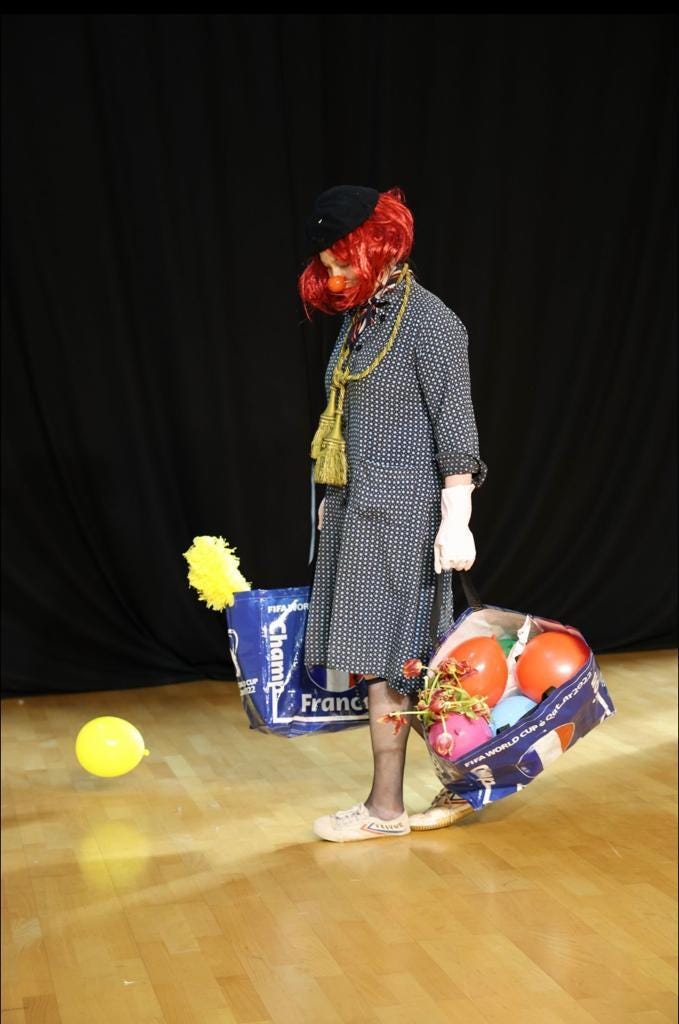
Photograph: Pain Rien at Ecole Philippe Gaulier by David Garcia Coll
The burden of my usual script and defences is less funny. Pleasure is not about laughing like an idiot but being on stage wrapped in nothing but your imagination. Being taught to recognise when I’m flopping and to consciously walk right into it has been unburdening. The elusive craft of ‘Monsieur Flop’, as Gaulier calls it, is that moment on stage where a clown has ‘failed’ in complicity with the audience…he or she appears to be dying whilst closely listening to the crowd…they can’t help but laugh. This cannot be forced or artificial. An ongoing reflective practice wherein success and beauty emerge from failure, where the laughter and the life both live. To consider my own failing as fertile ground was exciting. There is something vitally creative about being estranged from, or outside of, myself. This makes me wonder if The Freudian slip and The Flop are kindred spirits. A nugget of error which leads to truth.
I returned home to The Mews Coachworks, revived and happy to be back with the process of maintaining a studio and keeping the home fires or kilns burning.
And here I am.
I notice the weather and its effect on making, for myself and other makers. The summer heat is hard to work with, especially without fans, which would blow the clay dust around. It takes stamina to focus and be physically present with the material.
Wisteria is growing around the door, and within. There have been two blue tits exploring the studio, confusing themselves about how to get out. We wonder if they have built a nest on our roof. They are gathering, assembling, and clowning around.
Feeling lighter and braver, I’ve tried to reclaim an identity as a painter. The paintings I last exhibited were called ‘The Entitled’. At that time, I thought a pared-back, skeletal representation was what I was after. Yet I’m discovering there is an elusive quality to fleshiness as well. Painting on clay is a strange, risky, and blind process.
‘The Entitled’ was a group of paintings I made in response to a random Bonhams catalogue I found in 2008 for an auction of portrait miniatures. A group of Georgian aristocrats, who had the means and desire to be immortalized in fixed frames. Stock still faces and torsos in perfect postures.
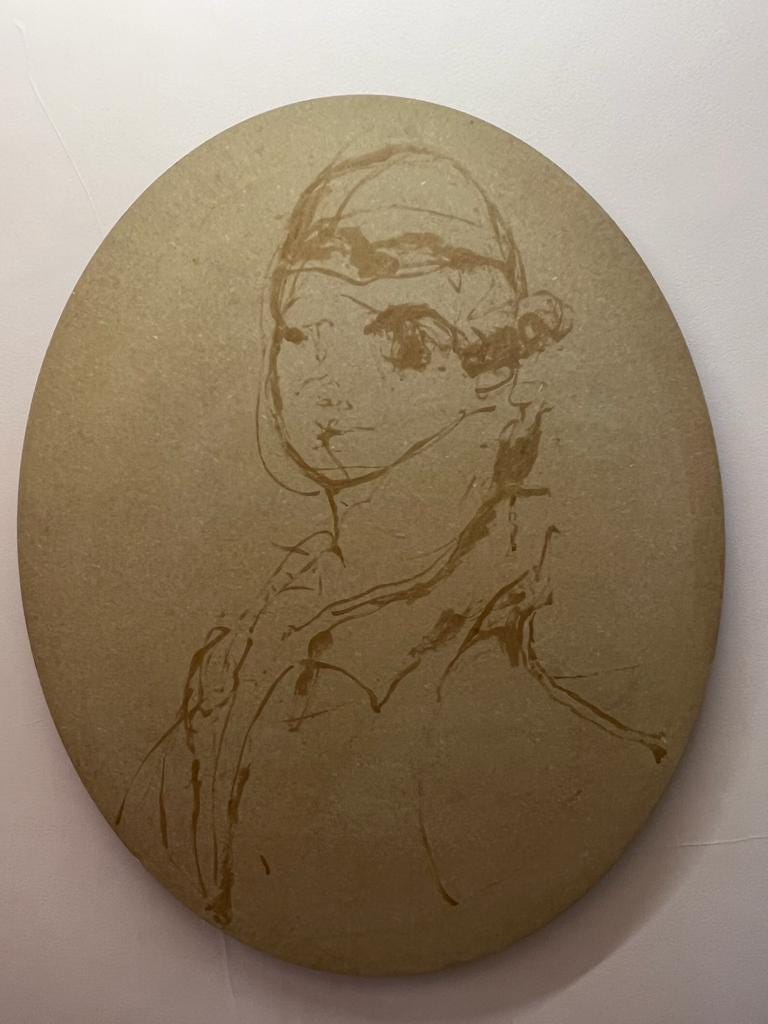
Photograph: ‘The Entitled’ - Abigail Schama from the exhibition ‘Not At Home’ 2008
Yet an official portrait is rarely a true likeness. How do you capture a flop? The flop is a feeling transmitted between audience and performer, a spirit of understanding. . An X-ray shows the bones or supportive structure of a vessel, be it pot or person. An X-ray cannot show internal wranglings.
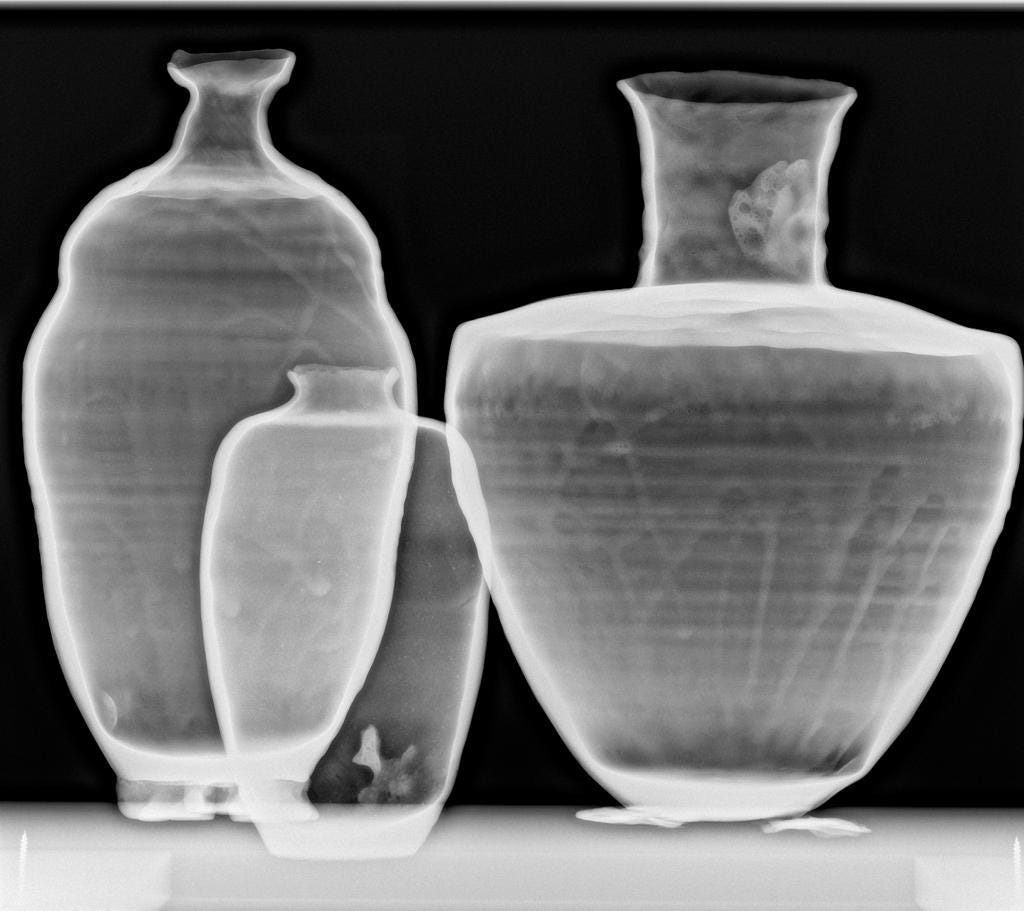
X-Ray Image: ‘Interior Workings’ - Abigail Schama 2019
The reassurance of a mug or bowl is in how familiar we are with how steadily it works.. What it holds and has held is considered transitory. Yet the sum of those experiences is absorbed into the pot’s skin . This is how domestic objects become animated. The painted miniature faces, meanwhile are stationary, or, to use a pottery word, vitrified.
My objects are perceived as familiar, yet with a sometimes distorted perspective and threatening likeness. They might partially flop, or tear. No two are alike. All have the potential to function in some way. I like to play with intimacy and peril, preciousness and neglect, helpfulness and helplessness cohabiting in one shape. I’m making likenesses of useful vessels. Sitting with their flop.
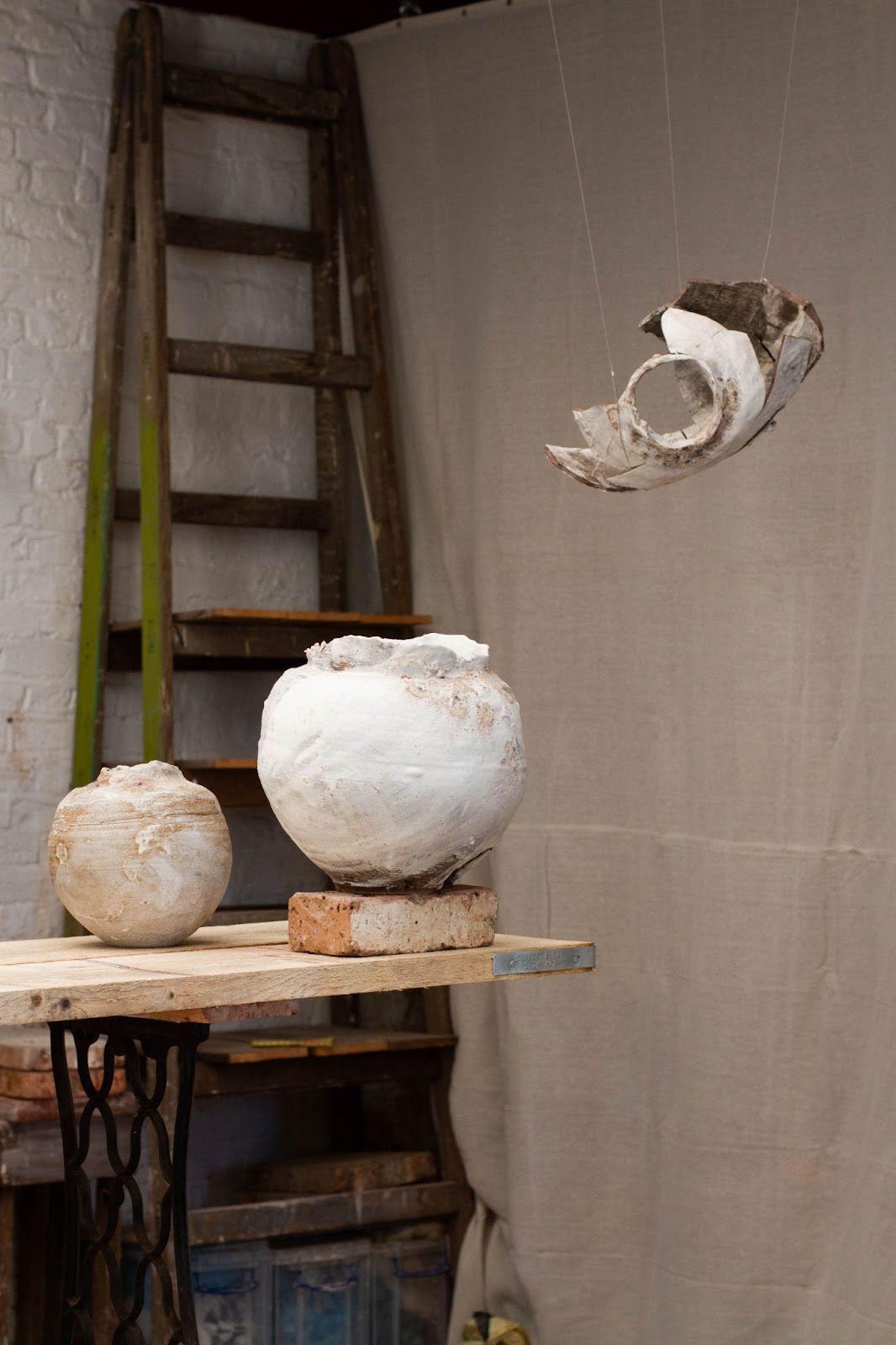
Photographs: ‘Listening Devices’ - 2021 by Charlotte Speechley for London Craft Week in support of CPU
Even portraits can make something of the flop.
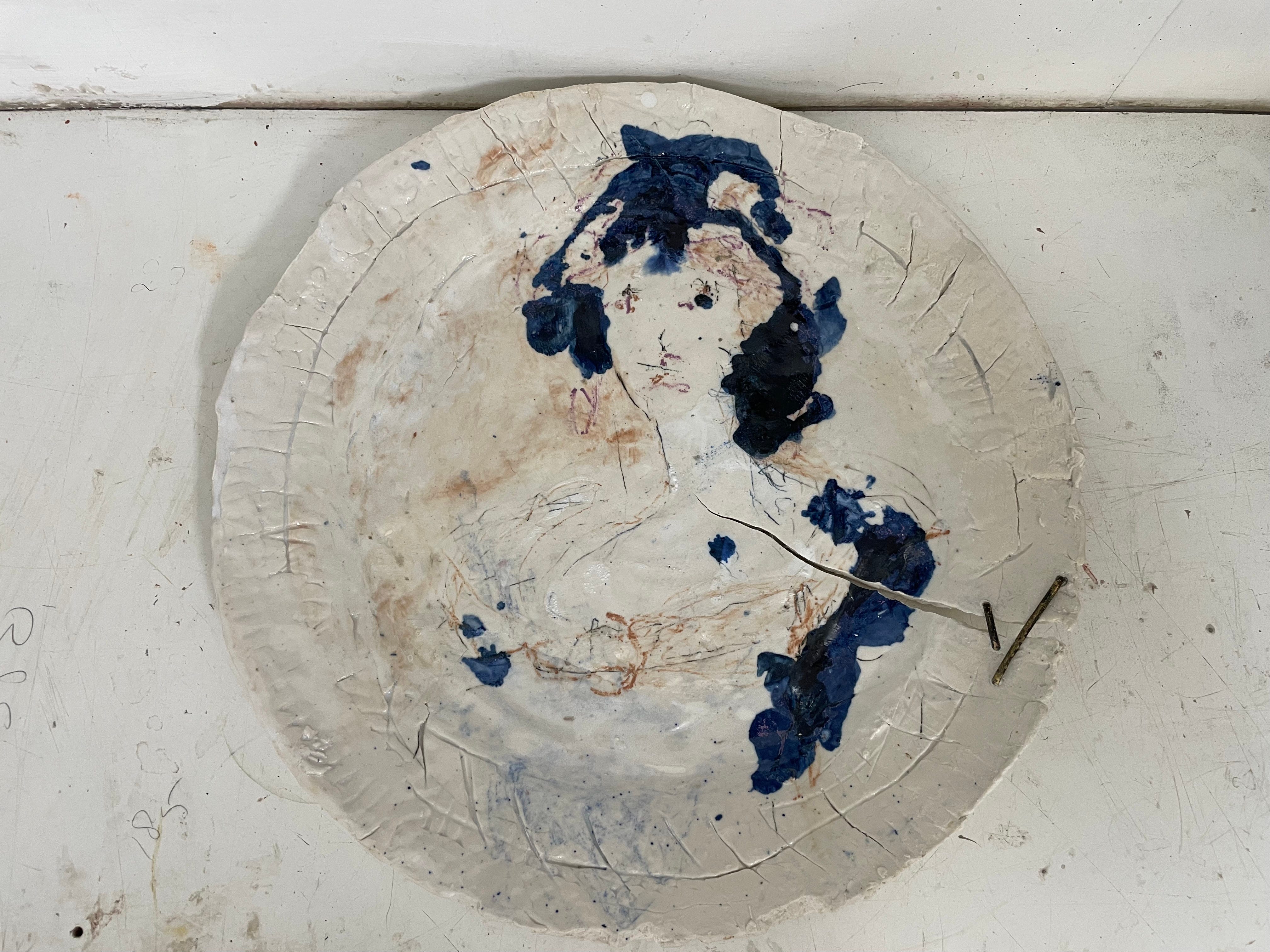
The character of the piece below inspired me to see my friend Bouke de Vries, who reassembles ceramic fragments. I wanted to emphasise its break in a glorified way in the direction of the character’s dynamic; She puts me in mind of a Jewish mourner whose shirt or dress is ripped to show her grief.
I am not a writer, or a clown, mudlarker, potter or painter.
I strive to make works which writhe, wriggle, itch and wrangle.